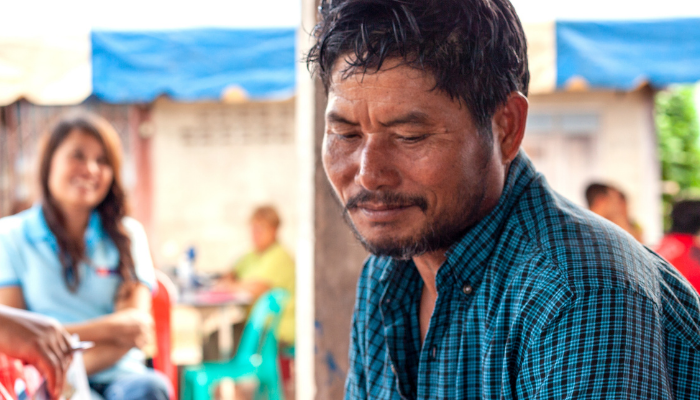
Wife-Beating Drunk Meets Jesus

Wife-Beating Drunk Meets Jesus

After she became Jesus’ disciple, Gia* began to share her testimony with others in her village. Her testimony and the power of God’s word brought many, including Elif*, to faith in Jesus. 

Elif’s husband, Rahj*, became angry and threatened to harm Gia. He was known throughout the village as an alcoholic who beat his wife regularly and had even threatened to kill her. Gia decided to leave town for a little while. 

Meanwhile, Elif prayed for her husband. “If Gia’s Jesus truly is real,” she reasoned, “then he will change my husband’s heart.” One day, while Elif was praying, Rahj found some pages from a New Testament and read them. God opened his eyes, and Rahj decided to follow Jesus. From that point on, he was changed. He stopped drinking and beating his wife. God answered Elif’s prayers. After Rahj came to faith, Gia returned to the village. 

Before long, Gia and Rahj decided to have a prayer and testimony night in their village. Rahj wanted to provide food for those who came — his way of showing that he had changed. Around 150 people showed up, roughly 35 households. These families were both Muslims and Hindus. 

Gia and Rahj shared their testimonies, led a prayer time, worshiped Jesus through songs, and shared how Jesus changes people and frees them from demonic powers. Many of the families wanted to start listening to gospel stories. 

They began listening to the Bible from mp3 speakers, obeying what they learned, and sharing the stories with others. More than 50 new families have requested to have Jesus’ stories to bring to their communities. And recently, six new people obeyed God by being baptized!  

*pseudonyms

IN SPITE OF THE BEATINGS
Unfortunately, her husband didn’t like her going to these meetings. He beat her after each one. He had no job… read more 

IT MUST BE JESUS WHO DID THIS
*Uhn was the town drunk and the senior patriarch of his large extended family. Over a year ago, a movement catalyst,… read more

THE DETERMINED NEW DISCIPLE
I don’t want you to tell my people about Jesus. It is my duty to tell them, and I passionately want to, but I, … read more 

Vesak

Vesak

Vesak is considered to be the most important Buddhist holiday. The celebration honors Buddha’s birth, enlightenment and death. Many believe that the three seperate events happened on the same day of the year throughout Buddha’s life. The holiday is known by many different names around the world. 

Generally, Buddhists celebrate the day by visiting temples, making offerings, and reflecting on Buddha’s teachings. Each region has its own additional traditions for observing the holiday. While some Buddhists, like those in Myanmar, Malaysia, and Sri Lanka, celebrated Vesak in early May, Buddhist Thais, Singaporeans, and Indonesians will celebrate during the first weekend of June (2-4).

Let’s pray for Buddhist peoples:

  • Ask God to open their spiritual eyes to the truth. Pray they would discover the God of the Bible as Creator and Lord of all humanity. Pray they understand that Jesus is the only one who defeated death (1 Corinthians 15:3-9) and the only one through whom we can defeat death
    (1 Corinthians 15:21-22). 
  • Pray for gospel messengers to speak boldly and present Jesus as the only one who can forgive sin.
  • Pray for church planters to understand the socio-cultural dynamics surrounding Buddhist society so they find ways to start and establish new communities of faith (churches).

LEARN ABOUT OTHER FESTIVALS AND HOLIDAYS

THE FESTIVAL OF COLORS
… bright, powdered pigments that are a trademark of this festival… LEARN MORE

LOY KRATHONG
Loy Krathong or Loi Krathong (ลอยกระทง), also known as Thailand’s Festival of Lights, is one Thailand’s …  LEARN MORE

THE FESTIVAL OF LIGHTS
A celebration of light triumphing over darkness … LEARN MORE

Revitalized Vision for Reaching the Lost

Revitalized Vision for Reaching the Lost

Recently Greg* and one of his local partners started meeting with a group of tribal believers to cast vision for multiplying disciples, and encourage them to obey Jesus’ commission in Matthew 28. Many of these precious brothers and sisters are farmers and laborers, some of whom trek over six miles through the forest and over steep hills to meet in a church building made of mud and thatch. 

Starting with Old Testament Scripture, Greg and his partner showed how Father God’s heart has longed for all peoples and nations from the beginning. They shared how Jesus lived his life as a pattern for us to follow, then gave his disciples the responsibility of the Great Commission. By the third visit, they sensed the people were accepting their responsibility to obey Jesus. Greg asked what experiences they’d recently had in trying to share the Good News with unbelievers. 

One young man stood up and said, “Brother, I am only a simple mason. I don’t know much. But after you shared about the simple ways we can engage those around us in conversation, I had an opportunity. On the job that day, rather than taking along friends I already knew, I purposely asked my boss to choose people to work with me. The two men I ended up with were brothers. They come from a nearby town that has few or no believers. When they saw my behavior and that I was not chewing “gutka” (the local tobacco-like substance), they asked me why. This started a conversation about how my life has changed. These brothers were impressed with my testimony and invited me to visit them at their home. This town is new for us, and my wife and I are praying for a chance to go meet with these men and their families to share the Good News.” 

After that brother sat down, Greg pointed out that since they live among so many unreached people, their places of work and the activities of their daily lives can provide many opportunities to share the Good News. Everyone accepted the challenge of finding new people and places to share the Good News before meeting again. When the local pastor stood to pray, he told Jesus they wanted to share with many people and asked Jesus to show them all how and where to find persons of peace. 

Pray for this group of energized followers to be directed by the Spirit and to have rich and fruitful conversations with many in their communities. Ask that these conversations would lead to Bible studies and new generations of multiplying disciples.

*pseudonym

WHAT CAN I DO vs WHAT NEEDS TO BE DONE
… we’ve had the privilege to walk beside others who have seen great fruit in ministry, and as we’ve constantly been willing  read more …

GOING OUT AMONG THE LOST
The women started a conversation, sharing upfront that they were followers of Isa (Jesus). They found the couple to be friendly and polite. In the course of talking read more …

DO YOU GO BEYOND THE FOUR WALLS?

The idea of reaching lost people more effectively by going outside the four walls of the church is daunting. Choosing to go to the lost …read more …

When Tradition Clashes: A Story of Humility and Discovery

When Tradition Clashes: A Story of Humility and Discovery

When a Christian woman visited another state in India last year, she met some believers from the North India movement. She was attracted to the simple way they love and obey Jesus and wondered if they could help her and her husband with their ministry in Goa. She called Sanjay* to ask if he would train some of their church people in this “new” approach to discipling. He readily agreed.

Here’s a translation of Sanjay’s trip report:

I went to a lady’s house. They didn’t know me. I didn’t know them. They thought I was coming to show off like other ministry leaders. They asked where I was going to sleep that night. I can sleep in your house; the floor is fine. They didn’t expect that. [I could see that the woman ] distrusted me [because I didn’t act the way a typical minister would]. I lived simply. I didn’t need the fancy chair, special introduction, or fancy treatment. I came to work, not for a holiday or to be honored.

We had the meeting. Many people came, especially ladies. I shared about [the importance of having spiritual] generations, making disciples, DBS [discovery Bible study], and working with the poor, even without money. They loved it. 

But the woman looked very disturbed. I can tell you are angry, I said. What is the problem? She said she felt judged by all I had shared. I had stressed things they hadn’t done. I am not judging you, I replied. I am just looking at what Jesus commanded us to do. Nothing else.  

After our conversation, she decided this was good teaching. But her husband didn’t like any of it. He wanted me to be like other Christian leaders. He thought I must be trying to trick or cheat them because [my presentation] wasn’t nice or fancy, and I didn’t want special treatment.

The husband and wife talked after lunch. I learned later that the man was so angry with his wife for changing her mind about me and this work that he slapped her face.

After lunch, we met with a different group. Again, I spoke about generational growth, disciple-making, and DBS. The husband was resistant to the end. He said, Tell us how much you will pay us, and then we will do this work. I told him, If you work for the Lord, the Lord will pay you. I will not.

The Lord gave me an idea. I asked, Would any of you like to know more about this work? A few said Yes. When it was time to leave, I gave the man and his wife a small gift of money as thanks for my stay. I welcomed them to contact me if they want to pursue this work. I also told them that a few people wanted to know more. Since no one is getting paid, the man agreed that I could work directly with the interested ones [bypassing him]. 

I thank the Lord. Through this man who’s not good-hearted, the Lord connected me with eight sincere people. This month, I will do some online training with them, and I will return and continue to train those applying what they learn.

Talk about obeying Jesus’ new command! Sanjay didn’t shy away from the woman when he saw her upset. He pressed in. In doing so, he obeyed Christ’s command to love as He loves. Please join us in praying for this husband and wife in Goa. Pray, too, for these eight people eager to apply what they heard. May they bear abundant, lasting fruit.

*pseudonym

8 MONTHS, 5 GENERATIONS 64 BAPTIZED
“When we see generational growth, we know the work is going well….If we don’t have generational growth after 5 or 6 trainings, something is read more …

THE QUIET GUY DISAPPEARED
Sanjay and John, national partners of BEYOND’s South Asian field leaders, conducted a series of disciple-making trainings in Northern India. One of the participants read more …

BALKING AT BAPTISM
In North India, the Banjara are a poor and marginalized people. They live in tents next to open sewage at the side of the road. They eat leftovers that people throw to dogs.  read more …

What Must Be Done?

What Must Be Done?

by Stan Parks

In some movements, the obedience question is “Since this Bible passage is true, how will you apply this in your life this week?” As you have read about movements starting movements, you might ask, “In light of this, what shall I do now?” An even better question is not, “What can I do?” but “What must be done?”

We don’t expect these movements to reach the world by themselves. God invites his global body to be part of finishing the Great Commission. We each have a part to play.

A seminary professor was urging prospective American church leaders to redistribute God’s resources to the rest of the world instead of lavishing it on ourselves. He said, “I say it respectfully, but I say it forcefully. God is not that stupid a general.” The disciples in movements are our most effective and strategic frontline Gospel messengers. We need to realign our Great Commission efforts to fully support them.

They are not asking or waiting for logistical and financial support to reach other people groups. They are already reaching out because they are empowered by the Holy Spirit and driven by their love for the lost and their desire to glorify God. But they recognize help from outside can enable them to reach more groups more quickly.

We need to avoid a misplaced nationalism that says, “Citizens of each nation must reach all their unreached peoples and places with no outside help, lest we promote dependency.” The  movements  are not asking for help  for  their  internal  costs  (to develop and sustain their movements). They fund those things locally. Yet as they plan and work to reach groups outside themselves, we can come alongside them and help with reaching each and every unreached group.

Six principles for helping movements should inform us all, regardless of our role.

  1. Prayer is first. The importance of prayer cannot be overstated. Informed, strategic prayer must be the foundation of every effort to reach the unreached. We are in a spiritual battle for the eternal souls of men, women, and  children.  We can’t afford to fight with earthly weapons. Every disciple of Jesus can play an important part in this, no matter their location or situation.
  2. Aim for holistic Church Planting Movements (CPM), not for various ministries as an end in themselves. CPMs are not one type of ministry alongside other types of ministries. Community development, medical work, arts, media, and Bible translation — all can both help begin CPMs and blossom as fruit of CPMs. As Jesus establishes his church, all the various types of transformative ministries will arise from within the church in that culture and community.
  3. The entire body of Christ is needed. 1 Corinthians 12 shows the need for honoring and collaborating with the whole body of Christ.
  4. True partnership among local disciples and outsiders. National and international outsiders need to defer to the necessary leadership of local disciples. At the same time, local leaders need to humbly encourage true partnerships.
  5. Funding should empower. All too often money  is given in a disempowering and dishonoring manner. Funding should be based on outcomes rather than activities, particularly when these movements have a long record of fruitfulness. One exciting model is foundations prioritizing assistance for movements and setting up task forces of movement catalysts and leaders to help evaluate the proposals.
  6. Cooperation not control. Many  movements have arisen from cooperation among national and international denominations, churches, seminaries, and agencies. This requires honoring one another despite different approaches, while honestly evaluating the impact of various efforts.

As you consider ways to help movements cascade, keep these things in mind.

1) Movements are not waiting for you to volunteer. You will need to patiently and graciously offer your help without demanding anything from movement leaders. You can imagine the load they carry, with movements doubling every 3.5 years, while trying to reach out to new peoples and places. And most live and serve in the midst of brutal governmental and religious opposition and persecution.

2) You may not be able to connect directly with movement leaders, due to security, their lack of time, or other considerations. But there are other ways to serve.

3) Movement leaders are looking for people to first and foremost be their brothers and sisters. As relationships and trust are built, possibilities for you to help may emerge.

4) You need to do all you can to learn about movements and become a movement practitioner right where you are. Your potential for being helpful is greater if you yourself are living a disciple-making lifestyle.

You may be called to be a Movement Servant. (See “Movement Servants Needed!” in MF May-June 2021, 37-41 and “Movement Servants — Helping Movements Multiply” in MF Nov-Dec 2022 for some specific ways you might help.) This involves patiently preparing yourself, and at the right times doing your best to do anything and everything asked of you by the movement(s) you serve.

However, you do not have to be a full-time movement servant to help. You could help in a wide variety of ways, including prayer, research, crisis response, medicine,  community   development, business for access to new areas, media 4 movements, funding, technology, Bible and media distribution, administrative help, supervising interns, etc. ‘For up-to-date information about these items and other possibilities, email us at cascade@2414now.net

Individuals, teams, churches, organizations, and agencies — what could you do to involve (or better involve) your entire group in these efforts? What could you give up? What could you change? Are you willing to make radical changes?

We thank God for what he is doing through movements in our day. Especially for the spontaneous multiplication of movements planting other movements among the unreached. Are you willing to lay aside whatever you need to, in order to be a part of doing whatever it takes to see movements in every unreached people and place in this generation?

About the Author: Stan is a Church Planting Movements trainer and a coach for leaders of Church Planting Movements around the world. He has been serving Unreached People Groups since 1994 while based in Indonesia, Singapore and Dubai. He is Co-Facilitator of the 24:14 Coalition which is focused on Kingdom Movement engagements in every Unreached People and place by 2025.

This article was first published in Mission Frontiers: Cascading Gospel: Movements Starting Movements, Jan/Feb 2023, pages 38-39. It was used here with permission.

Interested in ways to get involved?  Talk to Us
Want to Learn More About Movements? Watch our Six Simple Shifts Video