Berated for Bringing a Foreign Religion

Berated for Bringing a Foreign Religion

About two months ago, we told you about Gaden’s village. Here is a report from a more recent trip into the same village.

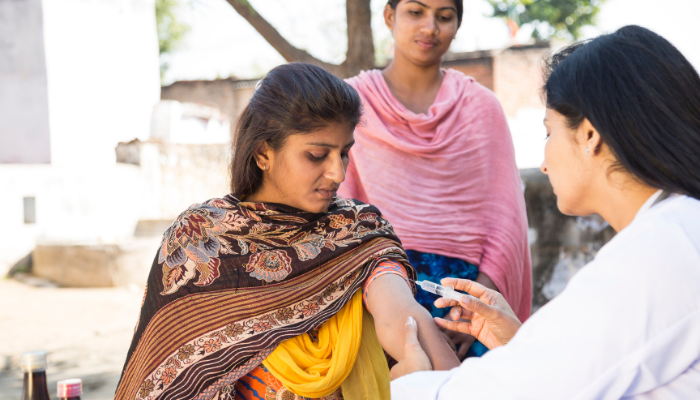
Joel* and his team of local disciple-makers were back in Gaden’s* village. They were going to conduct some basic health education and screenings, but they were primarily interested in visiting the young Discovery Bible Study (DBS) group. They hoped the group might want to be baptized. 

Instead, the team was perplexed when the DBS people didn’t want to be seen with them. They kept walking away and avoiding conversation. Something had changed.

That night the local disciples quietly visited one of their houses. But the young man’s mother, Metog*, berated them for bringing a foreign religion into their village and involving her son in their “corrupt work.” The team left dismayed but praying for God to intervene.

The next day, Metog saw something unusual happening in a nearby courtyard. As she approached, she saw a nurse checking a neighbor’s blood pressure. Metog, too, needed medical attention. Approaching Priscilla*, one of the disciples she had scolded the night before, Metog asked if the nurse could come to her house for a private check-up. They agreed to come. 

In the course of the check-up, Metog’s behavior completely changed. She declared that Priscilla was now like her own daughter and said Priscilla should be sure to stay in her home the next time she visited!

When Joel’s team visited the following year, they found the group of young people once again studying the Bible. “We have shared this Scripture with the whole village,” one exclaimed. “Everyone has heard it!”

You can dispatch more compassionate disciples like Joel and Priscilla!

*pseudonym

Part 1: What is a Church Planting Movement?

Part 1: What is a Church Planting Movement?

by Stan Parks

A Church Planting Movement (CPM) can be defined as the multiplication of disciples making disciples and leaders developing leaders. This results in indigenous churches planting churches. These churches spread quickly through a people group or population segment. Communities are transformed as new disciples and churches live out Kingdom values. 

When churches reproduce consistently to four generations in multiple streams, the process becomes a sustained movement. It may take years to begin. But once the first churches start, we usually see a movement reach four generations within three to five years. In addition, the movements themselves often reproduce new movements within other people groups and population segments.

God’s Spirit is launching CPMs around the world using a variety of models or strategies. Terms used to describe these models include Training for Trainers (T4T), Discovery, Discovery Bible Study (DBS), Disciple Making Movements (DMM), Four Fields, Rapidly Advancing Discipleship (RAD), Zume, etc. Many movements are hybrids of these various approaches, and many have developed indigenously outside of these training models.

Church planting movements resemble what we see in the New Testament.

“But you will receive power when the Holy Spirit comes on you; and you will be my witnesses in Jerusalem, and in all Judea and Samaria, and to the ends of the earth.” (Acts 1:8)

All of them were filled with the Holy Spirit and began to speak in other tongues as the Spirit enabled them…. Utterly amazed, they asked: ‘Aren’t all these who are speaking Galileans? Then how is it that each of us hears them in our native language? Parthians, Medes and Elamites; residents of Mesopotamia, Judea and Cappadocia, Pontus and Asia, Phrygia and Pamphylia, Egypt and the parts of Libya near Cyrene; visitors from Rome (both Jews and converts to Judaism); Cretans and Arabs—we hear them declaring the wonders of God in our own tongues!’ (Acts 2:4,7-11)

But many who heard the message believed; so the number of men who believed grew to about five thousand. (Acts 4:4)

So the word of God spread. The number of disciples in Jerusalem increased rapidly, and a large number of priests became obedient to the faith. (Acts 6:7)

So the church throughout all Judea and Galilee and Samaria had peace and was being built up. And walking in the fear of the Lord and in the comfort of the Holy Spirit, it multiplied. (Acts 9:31)

But the word of God continued to spread and flourish. (Acts 12:24)

The word of the Lord spread through the whole region. But the Jewish leaders incited the God-fearing women of high standing and the leading men of the city. They stirred up persecution against Paul and Barnabas, and expelled them from their region. So they shook the dust off their feet as a warning to them and went to Iconium. And the disciples were filled with joy and with the Holy Spirit. (Acts 13:49-52)

When they had preached the gospel to that city and had made many disciples, they returned to Lystra and to Iconium and to Antioch, strengthening the souls of the disciples, encouraging them to continue in the faith, and saying that through many tribulations we must enter the kingdom of God. (Acts 14:21-22)

And some of them were persuaded and joined Paul and Silas, as did a great many of the devout Greeks and not a few of the leading women…. Many of them therefore believed, with not a few Greek women of high standing as well as
men . . .(Acts 17:4, 12)

Crispus, the ruler of the synagogue, believed in the Lord, together with his entire household. And many of the Corinthians hearing Paul believed and were baptized. And the Lord said to Paul one night in a vision, ‘Do not be afraid, but go on speaking and do not be silent, for I am with you, and no one will attack you to harm you, for I have many in this city who are my people.’ . . . (Acts 18:8-11)

This continued for two years, so that all the residents of Asia heard the word of the Lord, both Jews and Greeks. (Acts 19:10)

In these modern movements we see similar dynamics to what God did in the early church.

(Part two describes the dynamics and characteristics of a CPM.) Read PART TWO

If Jesus Suffered a Judas, So Could We

If Jesus Suffered a Judas, So Could We

“Where the persecution is strongest, the work will be the most. We have seen it before.”– Sanjay, a North Indian movement leader

Disciples of Jesus in India face persecution regularly. Recently, movement leaders sent BEYOND teammates photos of a bruised young man. He’d been beaten by radical Hindus and the police. In another area, police arrested two disciples for studying the Bible and imprisoned them for five days.

The leaders estimate that every day about 50% of the movement faces persecution in some form: verbal abuse, intimidation, being barred from village wells, abuse from unbelieving relatives, house church raids, even martyrdom. 

Sadly, it is not uncommon for “traditional institutionally focused” believers to betray house churches to radical Hindu groups, but we shouldn’t be surprised. According to Jesus, disciples aren’t greater than their master. If Jesus suffered a Judas, so could we.  (John 15:20)

By the same token, if Jesus taught His followers about persecution early in their walk, so should we. Thus, leaders share biblical examples of persecution with each family who wants to follow Jesus. Then they ask, How will you apply this story when persecution comes?

Leaders also pass on wisdom learned from their own arrests. Call your mentor. Tell the police that no one forced you to follow Jesus, and no one is paying you.

Finally, leaders teach new followers how to stand firm when “traditional” Christians attempt to hinder them. Jesus’ disciples shared the Good News without being ordained. They baptized others and met in their own homes. So can you.

The movement churches are not shrinking back. They’re loving their enemies and praying for their persecutors while boldly obeying Jesus’ command to go and make disciples of the lost. It’s a modern-day echo of Acts chapter four.

And just as God grew His church in the book of Acts, He is growing it today. Last year, there were 60,000 house churches in the movement. This year, there are 120,000!

*pseudonym

Rediscovering God’s Heart and Vision

Rediscovering God’s Heart and Vision

One of the most beautiful aspects of working toward movements of disciples who make disciples (a Disciple Making Movement) is the joy of taking other believers back to the Word to rediscover God’s heart and vision. All too often, the meaning and significance of Scripture get taken for granted, simply overlooked, or never applied.

But what a joy to open the Word with sincere brothers and sisters and ask, “What does God want to tell me through this Scripture, and how will I obey?” Those simple questions — those remarkable thoughts — have changed many lives already!  

Take, for example, the simple verse 2 Timothy 2:2: “And the things you have heard me say in the presence of many witnesses entrust to reliable people who will also be qualified to teach others.” (NIV)

What do you notice about that verse?  Did you catch the number of people mentioned at each step along the way: “of many witnesses . . . people. . . others”? They are all groups!  What does that indicate? Have we overlooked something important about discipleship?  What would happen if we focused on discipling groups rather than individuals? 

We are inspired and given new ideas when we go to God with his Word and then purposefully understand, apply, and obey it!


The Person, Not the Method

The Person, Not the Method

by Emanuel Prinz with Dave Coles

Over a period of three years, I conducted empirical research among effective movement catalysts to discover the traits and competencies possessed by pioneers effective in catalyzing a movement among a Muslim people group and which traits they considered to have contributed to their catalyzing of a movement. This resulted in a profile of an effective movement catalyst, including eleven traits and competencies self-reported as exhibited by all participating effective catalysts.

The data of my research suggest that the effective catalyzing of movements is not tied to any particular methodology, though all employed reproductive movement approaches. Different effective catalysts employ different ministry approaches, both in terms of their movement methodology and in their approach to contextualization. A quarter of the catalysts participating in this study skipped the question about their ministry approach, which points to likely hesitation on their side to put their approach “into a box.” In addition, more than half of those who answered the question used the “Other” option to describe their ministry approach in their own words. Often the description given was a hybrid of two or more of the other approaches. This means that the approach of most effective catalysts in this study is a hybrid of more than one ministry approach, which they have adapted to the uniqueness of their context. The research does not support any claims that one specific ministry approach must be followed precisely to lead to a movement.

With the exception of the approach of adding Muslim Background Believers (MBBs) to existing Christian Background Believer (CBB) churches, it appears that particularity of methodology does not correlate to success in catalyzing a movement. By definition, the traditional approach (planting a single church) is not conducive to catalyzing a movement. This could explain why the pattern of adding MBBs to existing CBB churches is not utilized by any effective catalysts. At the same time, 13% of the catalysts employed the approach of planting a new church comprised of MBBs which then reproduced itself and grew into a movement. The difference in these approaches is not methodological, but primarily sociocultural. The adding of MBBs to CBB churches involves the bridging of divides, whether sociological, cultural, ethnic, or linguistic. These barriers explain why adding MBBs to existing CBB churches is not an effective approach for catalyzing a CPM, whereas planting a new MBB church may be. Still, only 13% of all movements examined have been catalyzed with such an approach.

The overwhelming majority of movements were catalyzed with one of the various movement approaches (those of D. Garrison, Watsons/Trousdale, S. Smith). These approaches have certain principles in common, including cultural contextualization, obedience-oriented discipleship, house churches, reproduction, training of multipliers, and reproducible resources. The overall emphasis in pioneer and apostolic leadership and movement literature has been on right methodology, with some attention to leader traits and competencies of the pioneer leader or leaders, particularly traits of a spiritual nature. However, the findings of this research go beyond the commonly established insights of Christian pioneer leadership. The data clearly suggest that a particular methodology is far less significant in catalyzing movements than may have been assumed or publicized. The data of this study clearly establish that certain pioneer leader traits and competencies are strongly associated with effective catalyzing of CPMs. This perspective has been voiced by only a few, most notably Neill Mims and Bill Smith, who formulated what are considered to be among the most significant insights of almost 20 years of research into CPMs: “At the end of the day, it is the man or woman of God and not the method that God blesses.”

Another of the few voices who have expressed this perspective is movement thinker Dave Ferguson, who concluded: “the greater the missional impact, the more obvious the pioneering apostolic leadership becomes.” The person of the pioneer leader(s), not the method he or she employs, plays the greatest role in determining whether or not a movement will result. Bill Smith is again among the few who formulated this accurate conclusion: “If someone says to me, give me the method or give me the curriculum, I know that they have not understood that this [the catalyzing of a movement] is accomplished through persons rather than methods.”

The right leader(s) will employ the right methodology. A pioneer leader with traits such as radical learning, intelligence, complex thinking, innovation, and initiative, who then possesses the necessary socio-influential and transformational competencies, has the best potential to identify and implement the most effective methodology for the context in which he or she is operating. However, a person who receives a methodology, but lacks the traits and competencies identified in this study, will be unable to effectively apply the methodology. This stands in stark contrast to the conclusions of many publications on movements that center around methods and principles rather than on the person of the catalyst. I hope the clear data of this research will jolt a paradigm shift in the field of catalyzing movements.

This article was first published in Mission Frontiers and was edited with permission.  Order the book, Movement Catalysts by Emanuel Prinz